Solid from footing to cap. Nothing else gives you a complete visual barrier the way masonry does.
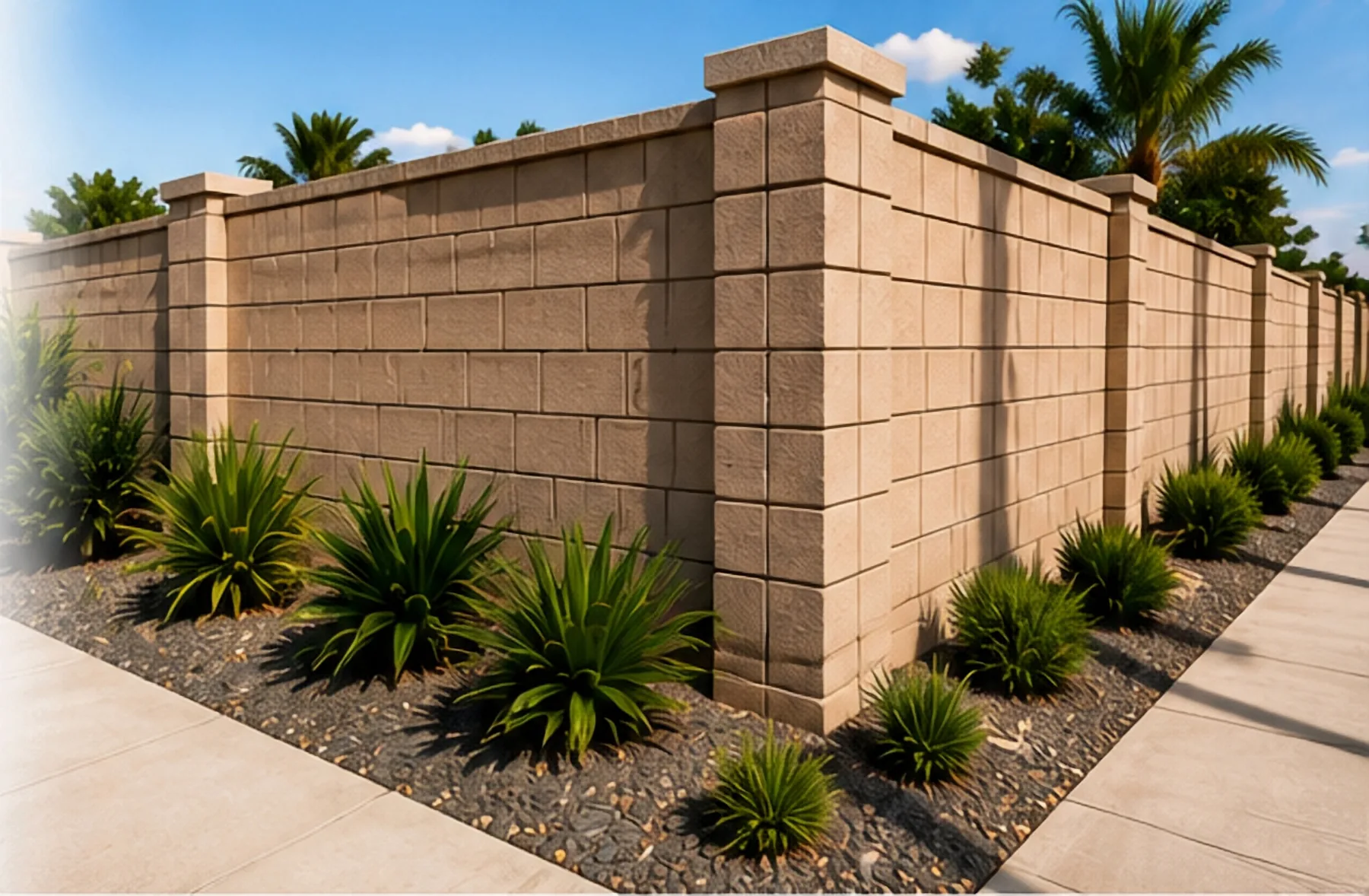
Block Wall Fence
Strong.
Private.
Built to Last.
A block wall gives you strength, privacy and permanence that no fence can match. Built to stand the test of time, it protects the property, cuts the noise from the street, and adds real value to the place.
Features & Benefits
Why homeowners choose block walls
Maximum Privacy
Unmatched Strength
Wind, impact and time. A properly footed block wall outlasts every other boundary on the property.
Noise Reduction
Mass is what blocks sound, and only masonry has it. On a busy street this is the reason people build one.
Weather Resistant
Rain, wind, sun and fire. There is nothing in a block wall for weather or termites to work on.
Low Maintenance
Essentially none. Hose it down, keep an eye on the cap, and repaint stucco every several years if you want.
Increase Property Value
A finished masonry boundary reads as permanent, and buyers price it that way.
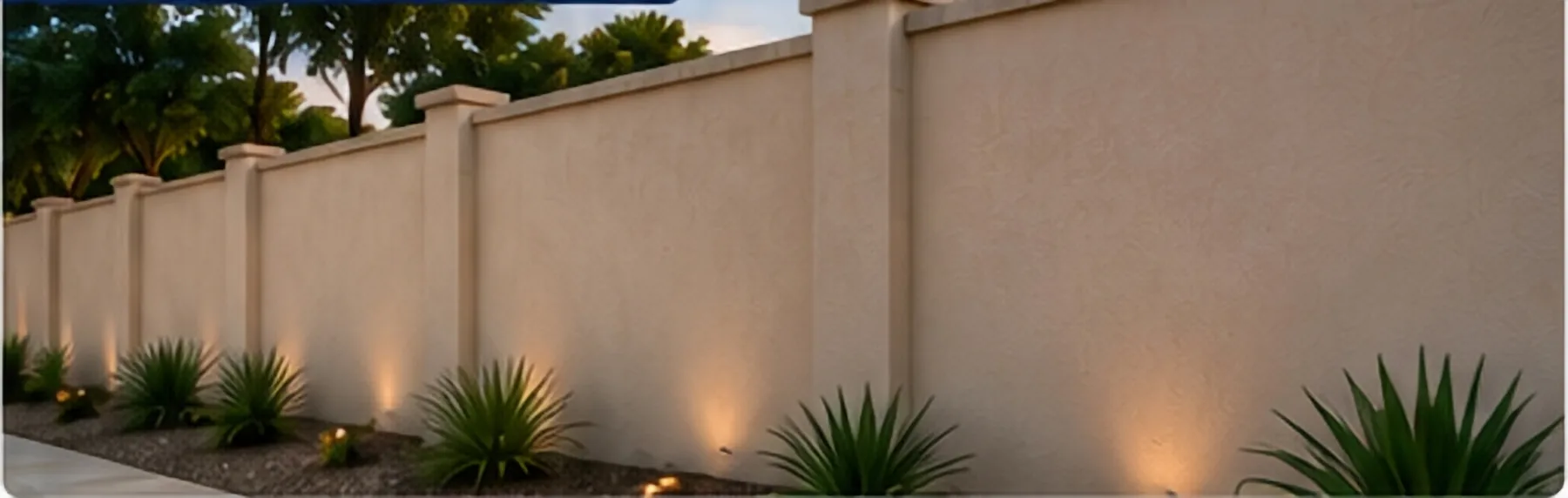 With smooth stucco finish
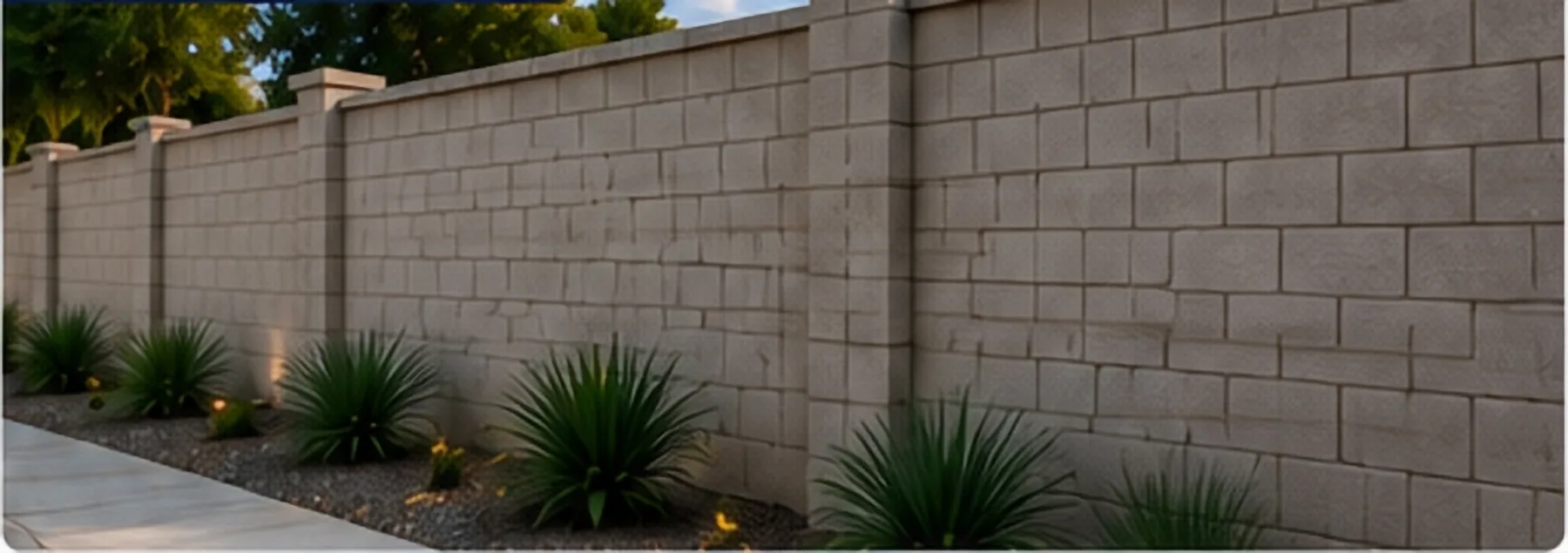 Without stucco finish
Style Options
Block wall styles
 Smooth Stucco Finish
Clean and modern, with the block hidden behind a smooth coat. Takes colour, so it can be matched to the house.
 Traditional Block Finish
The classic look. Strong, durable and the most cost-effective way to build, with a timeless appearance.
Our Process
Professional installation,
every step of the way
1Free Consultation
We walk the line, look at levels, drainage and access, and talk through height and finish.
2Custom Design
Layout, height, pilasters, gate openings and finish agreed, then a written price with nothing hidden.
3Expert Construction
Footing dug and poured, steel set, block laid to line and level, cores filled where the design calls for it.
4Quality Finishing
Smooth stucco or left as clean block, with the cap detailed to shed water off the top.
5Final Walkthrough
We walk the finished wall with you, check every detail and clear the site properly.
Los Angeles Block Wall Fence Contractor
Los Angeles block wall fence contractor
We build block wall fences for homes and businesses across Los Angeles. Whether the driver is privacy, security or simply a boundary that looks like it belongs, we build walls engineered to last rather than walls put up quickly.
From smooth stucco finishes to classic block, we use quality material and proper masonry practice — a footing sized for the ground, steel through the cores, and a cap detailed to shed water.
Protect the property, cut the noise and add lasting value with a wall built right the first time.
Block Wall Guide
Block wall and brick wall construction in Los Angeles
Why the footing decides everything, what the steel inside a wall actually does, how retaining walls differ, brick against block against brick-faced block, which cracks matter and which do not, and the six questions to ask anyone quoting masonry.
On this page
The footing is the wall
A block wall is a heavy, rigid structure sitting on the ground. Everything about whether it stands straight for forty years or cracks in five is decided before the first block is laid.
We dig and pour a footing sized for the wall height and the soil under it, with steel through it, and we let it cure before building on top. It is the least visible part of the job and the most expensive part to get wrong — a wall on an inadequate footing does not sag quietly like a fence. It cracks, and a cracked masonry wall cannot be quietly patched.
Los Angeles soil moves. It bakes hard through summer and softens through the winter rains, and expansive clay in parts of the county moves more than most. That is not a reason to avoid block; it is a reason to size the footing for the ground you actually have rather than a standard number.
If a quote does not mention footing depth or reinforcement, ask. That single number is the difference between a wall and a future repair.
Steel, grout and why some walls are hollow
Concrete block is strong in compression and weak in tension, which is why a wall relies on the steel inside it.
Vertical bars run up through the block cores from the footing, and horizontal bars sit in the bed joints at set intervals. The cores containing steel are then filled with grout so the bar and the block act as one thing. Skip or thin any of that and the wall looks identical, right up until something loads it.
- Vertical steel tied into the footing, at spacing set by the wall height.
- Horizontal steel in the bed joints, tying the wall together along its length.
- Grouted cores so the steel is actually bonded rather than sitting in a void.
- Cap detail that sheds water rather than letting it sit on the top course.
Retaining walls are a different animal
A boundary wall holds itself up. A retaining wall holds soil back, and soil pushes constantly — harder after rain, when the ground behind it is saturated and heavy.
That changes everything: a wider footing, more steel, and drainage behind the wall so water can escape instead of building pressure against it. Gravel backfill, a drain line and weep holes are not optional extras on a retaining wall, they are the reason it stays standing.
If your wall is holding back any ground at all, even a modest step in a sloping yard, tell us at the survey. It is a different design and it needs to be priced as one.
Stucco or bare block
Smooth stucco
A coat over the block gives you a clean modern face that can be coloured to match the house. It costs more, and it is the finish most people want on a street frontage. It does need repainting eventually, and hairline cracking in stucco is normal rather than a fault.
Traditional block
Left as laid, either standard grey or a split-face or precision block chosen for its look. Cheaper, effectively zero maintenance, and honest. It suits a rear boundary or a property where the wall is not the feature.
Split face, slump and decorative block
Between the two. A textured block gives you more character than plain grey without the cost or upkeep of stucco. Worth looking at samples before deciding — these read very differently in daylight than in a catalogue.
Brick walls, and how they differ from block
People often use brick and block interchangeably when talking about walls. They are different materials with different costs and different reasons to choose them.
Brick
Smaller units, more joints, and far more labour per square foot. That labour is why brick costs considerably more than block for the same wall. What you get is a look nothing else reproduces, and a material that is genuinely permanent when laid well.
Block
Bigger units, fewer joints, and a hollow core that takes steel and grout. Faster to build, stronger for its cost, and easily finished in stucco if you want a smooth face.
Brick face on a block core
The common compromise, and often the sensible one. A structural block wall does the work; a brick face gives you the appearance. You get the look of brick with the engineering and the cost of block, and for most residential frontages it is the right answer.
Pilasters, caps and gate openings
The details are what separate a wall that looks designed from one that looks poured.
- Pilasters. Thicker columns at intervals and at corners. They stiffen the wall structurally and break up a long run visually. Either side of a driveway they carry the gate.
- Caps. The top course has to shed water. A proper cap keeps rain off the wall face and out of the cores.
- Gate openings. Pilasters either side of a gate need extra steel and grout because they carry the leaf weight and the swing.
- Lighting and conduit. Far easier to build in than to add. If lights or an intercom are going on the wall, say so before it goes up.
Cracks, and which ones matter
Not every crack in a masonry wall is a problem, but the difference is worth knowing.
- Hairline cracking in stucco. Normal. Cosmetic, and expected as the coat cures and moves.
- Fine vertical cracks in a joint. Usually minor movement. Worth watching rather than panicking about.
- Stepped diagonal cracking. Following the joints in a staircase pattern means the footing has moved. That is structural.
- A wall leaning or bowing. Serious, particularly on anything retaining soil. Get it looked at.
- Cracking that has opened over months. Movement is ongoing rather than settled. Also structural.
We look before quoting because those categories need completely different work. Rendering over a structural crack hides it for one season and nothing more.
What a block wall costs
Block sits above every fence type on day one and below all of them over a long enough horizon, because it does not need replacing. What moves the price:
- Height and length. Height compounds — a taller wall needs a bigger footing and more steel, not just more block.
- Footing and ground. Soil conditions, slope, access for a mixer and whether there is anything to break out first.
- Retaining or free-standing. Retaining costs substantially more, and should.
- Finish. Bare block, decorative block or stucco, in ascending order.
- Pilasters and gate openings. Each one is extra material and labour.
- Drainage. Essential on retaining work, and a real line item.
Estimates are free and written. We survey the ground rather than quoting from a photograph, because on masonry the ground is most of the job.
Choosing a block wall contractor
Six questions worth asking anyone quoting masonry:
- How deep and wide is the footing, and what steel goes in it?
- What vertical and horizontal reinforcement, and at what spacing?
- Which cores are being grouted?
- Is this wall retaining any soil, and if so what drainage is behind it?
- How is the top being capped?
- How long between pouring the footing and laying block?
That last one is a good tell. A contractor in a hurry to build on green concrete is a contractor you will hear from again.
We build block wall fences, brick-faced walls and retaining walls across Los Angeles County, the San Fernando Valley and Ventura County. Locally owned and operated, and if a repair to your existing wall is the better value we will say so.
Build a stronger, more private
property with a block wall fence
property with a block wall fence
Get a free estimate today and let us design and build the right block wall for your home or business.